You are viewing the Initial Version, the most recent version of this dataset.
1 version(s) available
Date of publication: June 20, 2025

Version 1

Date of publication: June 20, 2025

Type of change:

Description:
preview image

Wild pollinator densities in European agricultural landscapes (NaturaConnect)

by Liam Vezzani

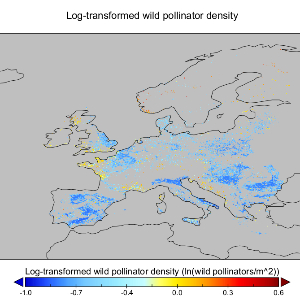
We estimated wild pollinator density (expressed as the natural logarithm of abundance per m²) in cropland cells across Europe for the current state and three future scenarios. The dataset encompasses two temporal references: one for 2020 and three future scenarios for 2050. All four maps were produced by independently applying the same statistical model to land system maps for each year. Results from 2020 are included in each future scenario for ...(continue reading)

DOI 10.25829/ka4q38
Citation
Vezzani, L. (2025). Wild pollinator densities in European agricultural landscapes (NaturaConnect) (Version 1) [Dataset]. German Centre for Integrative Biodiversity Research. https://doi.org/10.25829/ka4q38

modelEuropecroplandRCP scenariospollinators

90
The title of the dataset. Wild pollinator densities in European agricultural landscapes (NaturaConnect)
The date on which this version of the data was created in YYYY-MM-DD format.
A paragraph describing the dataset.
Hover to see a suggestion for a good description. Allowed:
We estimated wild pollinator density (expressed as the natural logarithm of abundance per m²) in cropland cells across Europe for the current state and three future scenarios. The dataset encompasses two temporal references: one for 2020 and three future scenarios for 2050. All four maps were produced by independently applying the same statistical model to land system maps for each year. Results from 2020 are included in each future scenario for structural consistency. We utilized the NaturaConnect (https://naturaconnect.eu/) land system maps for both the current state and future scenarios (Garcia et al., 2024; Sandström et al., 2023).

Sandström, E., Sarita Namasivayam, A., Oostdijk, S., Scherpenhuijzen, N., Debonne,, N., & Verburg, P. (2023). Preliminary land system map for Europe [Data set]. Zenodo. https://doi.org/10.34894/THARMK

Garcia, N., Scherpenhuijzen, N., Sarita Namasivayam, A., Levering, A., & Verburg, P. (2024). Preliminary land use scenarios for Nature Future Framework [Data set]. Zenodo. https://doi.org/10.5281/zenodo.14228230
Provide the DOI number of associated publications. Click Plus to add DOIs.

N/A

The method of production of the original data.
Hover to see a suggestion for a minimum description.
To build the dataset, we first built linear mixed effect models linking wild pollinator densities to the distance to the closest small woody feature (European Commission, Copernicus Land Monitoring Service, 2023), management practice and fraction of habitat within a 3 km radius. The underlying data was obtained from CropPol (Allen-Perkins et al., 2022) as well as from a literature review.

Allen-Perkins, A., Magrach, A., Dainese, M., Garibaldi, L. A., Kleijn, D., Rader, R., Reilly, J. R., Winfree, R., Lundin, O., McGrady, C. M., Brittain, C., Biddinger, D. J., Artz, D. R., Elle, E., Hoffman, G., Ellis, J. D., Daniels, J., Gibbs, J., Campbell, J. W., … Bartomeus, I. (2022). CropPol: A dynamic, open and global database on crop pollination. Ecology, 103(3), e3614. https://doi.org/10.1002/ecy.3614

European Commission (Copernicus Land Monitoring Service). (2023, May 10). Small Woody Features 2018 (raster 100 m), Europe, 3‑yearly [Data set]. https://doi.org/10.2909/89eeb6c1-ee72-44b3-b0e3-83c74f2c306d

European Commission (Copernicus Land Monitoring Service). (2023, May 10). Small Woody Features 2015 (raster 100 m), Europe, 3‑yearly [Data set]. https://doi.org/10.2909/2adfe942-186d-4ee0-af41-b8b864dfb6b6
The coverage content type describes the general content type of the resource (multiple selection possible).
The name of the Project.
The URL from the project website. https://naturaconnect.eu/
The name of the person or other creator type principally responsible for creating this data.
The email of the person or other creator type principally responsible for creating this data. lillovezza08@hotmail.it
https://orcid.org/
0009-0005-9257-1365
lillovezza08@hotmail.it
https://orcid.org/0009-0005-9257-1365
The names of the co-creators responsible for creating this data. Click Plus to add co-creators.
Select between Creative Commons (CC) or Non-CC license.
Please select the CC license from the list. We recommend the use of CC BY 4.0

Essential Biodiversity Variables

Select the EBV class and the EBV name for the dataset. For cross-cutting use the comment at the bottom of the page for further information.
Genetic composition
Intraspecific genetic diversity
Genetic differentiation
Effective population size
Inbreeding
Other
Species populations
Species distributions
Species abundances
Other
Species traits
Morphology
Physiology
Phenology
Movement
Other
Community composition
Community abundance
Taxonomic and phylogenetic diversity
Trait diversity
Interaction diversity
Other
Ecosystem functioning
Primary productivity
Ecosystem phenology
Ecosystem disturbances
Other
Ecosystem structure
Live cover fraction
Ecosystem distribution
Ecosystem Vertical Profile
Other
Ecosystem services
Pollination
Other
Cross-cutting

Entity

Select the entity type of the dataset.
Species
Communities
Ecosystems
Other
None
A description of the range of taxa or ecosystem types addressed in the dataset. E.g. "300 species of mammals”, “Forests”, etc.
The reference as a URL. N/A

Metric

Provide the name, description, units of minimum 1 metric. Click Plus to add metrics.

Scenario

If applicable, name the scenario's exercise, the version and provide a URL to the reference. https://doi.org/10.3897/arphapreprints.e134026

Spatial domain

Global
Continental/Regional
National
Sub-national/Local
Name of the continent/region/country/area, separated by comma
meter
southWest lat: 942000, lon: 944000
northEast lat: 5416000, lon: 6526000

Temporal domain

The targeted time period between each value in the dataset.
decadal
annually
monthly
weekly
daily
Other
Irregular
Single time
Select the temporal extent of the dataset.
When the dataset represents a Single time, then use the same start and end date.
__

Environmental domain *

Terrestrial
Marine
Freshwater
Miscellaneous information about the data, not captured elsewhere. Further details on the wild pollination layer generation can be found on the NaturaConnect 4.2 deliverable [https://naturaconnect.eu/deliverables/]
Entities
Pollinators